Today my MSc Audio Engineering group did our drum recordings for the Recording, Mixing and Remixing project.
We had a session drummer (Alex) in for the afternoon, who brought his own drum kit with him. The difference in sound between an amateur drummer on a mid-level kit and a professional with pro-level gear was hugely apparent when comparing to our demo recordings. Alex was an excellent drummer, and really easy to work with.
It reminds me how important interpersonal skills are when working in musical settings – just being a great engineer is no help to your career if nobody wants to work with you because you’re always grumpy or unhelpful!
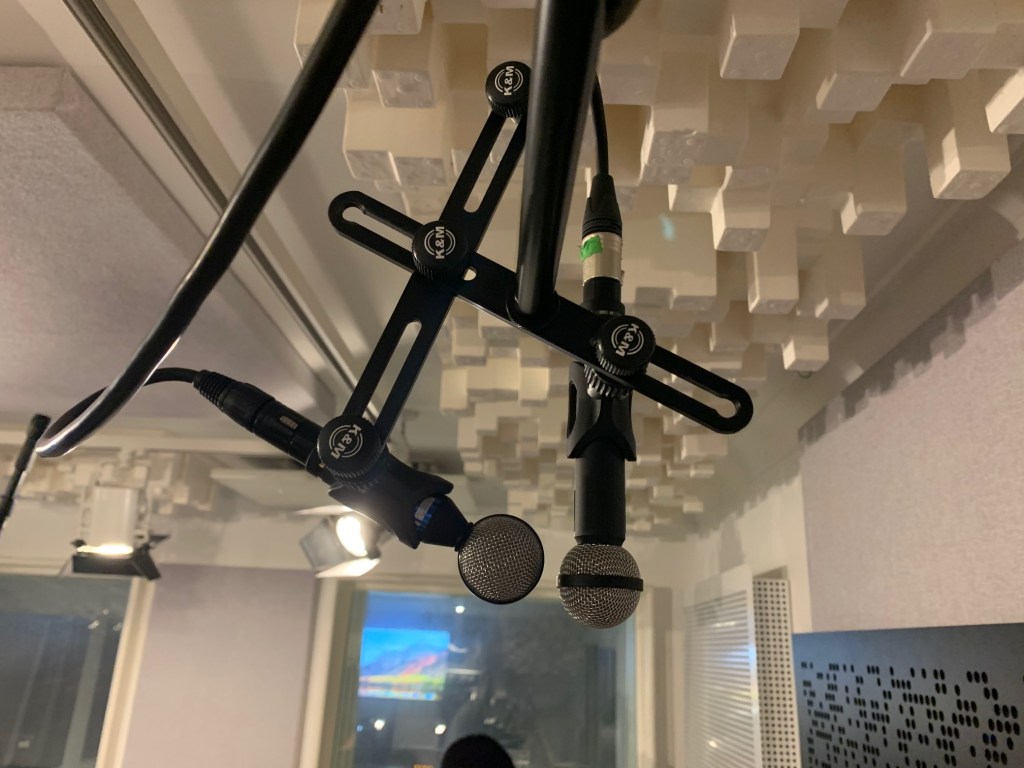
We attempted to use a few different recording methods to those I would usually employ when recording a drum kit – in particular we tried both Glyn Johns style overhead mics, as well as a mid-side stereo pair directly above the kit, using Beyer ribbon mics. I am particularly looking forward to seeing how the MS pair (pictured right) sound, as we were unable to monitor these while recording due to the nature of MS.
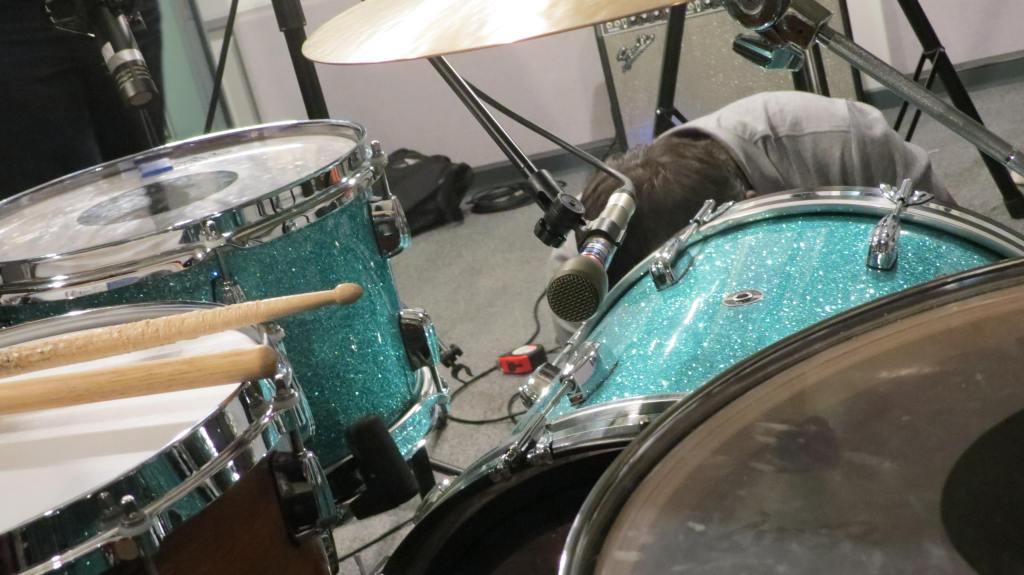
We also used a wurst mic placed in the centre of the drums, which is not something I have tried before, as well as a Crown boundary mic placed behind a pillar in the live room, which gave a surprisingly full impression of the whole drum kit. Once again, I drew some of these ideas from Huber’s (2019) Modern Recording Techniques, this time regarding tom mic placements and the use of the boundary mic to capture the full kit sound.
I think we may have some issues with the sound from our outside-kick mic, but other than that we got a decent sounding capture – I look forward to getting it mixed!

