In my last post I mentioned that my project is to build a Euclidean Sequencer – but what does this actually mean?
Those of us who create music will likely be familiar with the concept of a sequencer – a device or piece of software which allows us to send control messages to another noise-maker and tell it when to play notes, what notes to play, etc. So what makes this particular type of sequencer special?
The word Euclidean is primarily concerned with geometry – Euclid was a Greek mathematician of around 300BC, who posited that complex theorems could be constructed by setting a small number of simple rules, or axioms, and following these through to their logical conclusions.
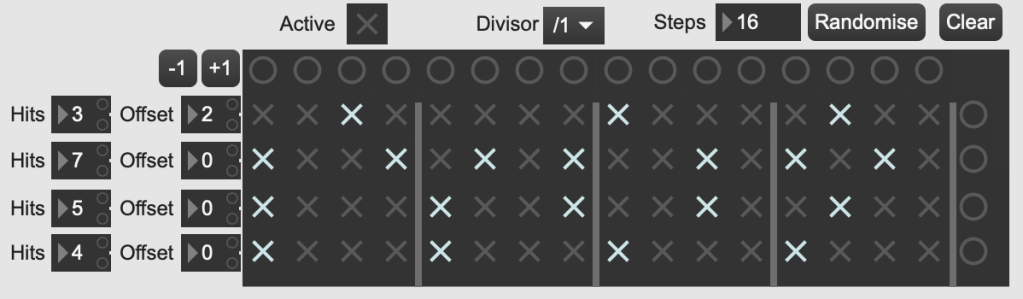
A Eculidean rhythm follows this structure, its only axiom being that notes must be spaced as evenly as possible. There are a few different ways that remainders can be assigned – in this case we are not concerned with this as long as things are as even as possible, and that methods remain consistent.
To generate our rhythm using this rule we therefore need two values:
- The number of steps in each cycle, or its length. In a 4/4 time signature this would usually be 4, 8 or 16 steps.
- The number of events which occur within each cycle. This is the number of times that a note will be played. For example, if this number were 3 in a sequence with a length of 8, then we would expect to hear 3 notes and 5 rests in each cycle.
On their own, these sequences are not particularly exciting, but when layered on top of one another they can quickly create interesting rhythmic textures and polyrhythms. By adding an offset value, we can then push these sequence forwards or backwards, potentially creating even more interesting musical interactions.
Here are a few links to some more information:
https://www.musicradar.com/how-to/what-is-euclidean-sequencing-and-how-do-you-use-it

