An important part of designing any product is understanding the market context, and knowing what similar products are already available. This prevents wasting time on accidentally creating something which already exists, and also allows a designer to focus on a specific market gap or USP for their product.
Some Google-based research shows that there are two popular modules available which fill a similar role to my idea, and several others which run single lane Euclidean rhythms and are also worth mentioning.
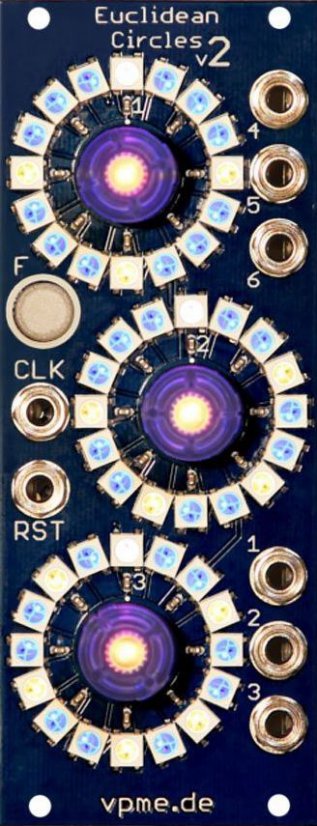
Euclidean Circles v2 by Vladimir Pantelic Musikelektronik
This module is available in either DIY or prebuilt form, and is very popular. It can run up to six separate 16 step Euclidean rhythms, with pairs displayed on each of the three LED rings. Step and offset parameters are input via knobs central to each ring. The only CV inputs are the clock and resets, and an external clock is required to run the sequence.
This v2 edition has some additional functionality, including user-edited sequences and a ‘function’ button which can be used for saving/restoring presets among other things.
One of my colleagues is an avid Eurorack user, and this module is an important part of his rig. When asked what he would change about this module if he could, he said that the biggest thing missing was a lack of CV control for the parameters.
Another slight issue I see with this module is the LED-rings. While these are excellent for sequences with a length of 16, they are rather confusing when using shorter sequences, and a linear sequence display may work better in alternative time signature applications.
More info here: http://vpme.de/euclidean-circles/
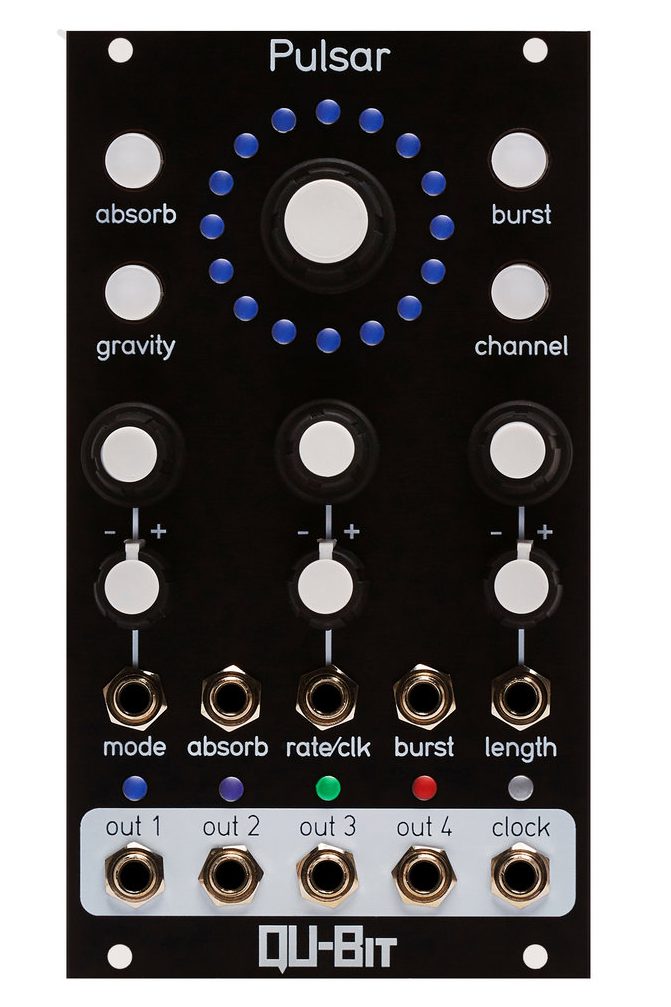
Pulsar by QU-Bit Electronics
This module is a powerful polyrhythm generator, and contains several different generation algorithms. The product launch video of this module actually introduced me to the concept of Euclidean rhythms!
Four output lanes are available, and display is given using different colours on the single LED ring. Once again, I feel this favours 16-step sequence lengths.
The addition of an inbuilt clock (and clock output) is welcome, meaning that this device can become a master for other sequencers, and five inputs are provided, which affect the generated rhythms differently depending on the mode of operation selected.
More info here: https://www.qubitelectronix.com/shop/pulsar

Euclid by 2hp
This simple single-lane module has inputs for each parameter of the rhythm, and a single gate output. It also has pots for each parameter, with each value being determined by both the pot position and inputted CV. This allows for either standalone operation, complete external control, or a combination of the two.
The small form factor of this module is a big advantage for often overflowing modular cases, and multiple modules can be chained together if more that one lane is required.
The tradeoff for these size advantages is the lack of display, and no internal clock.
More info here: https://www.twohp.com/modules/euclid
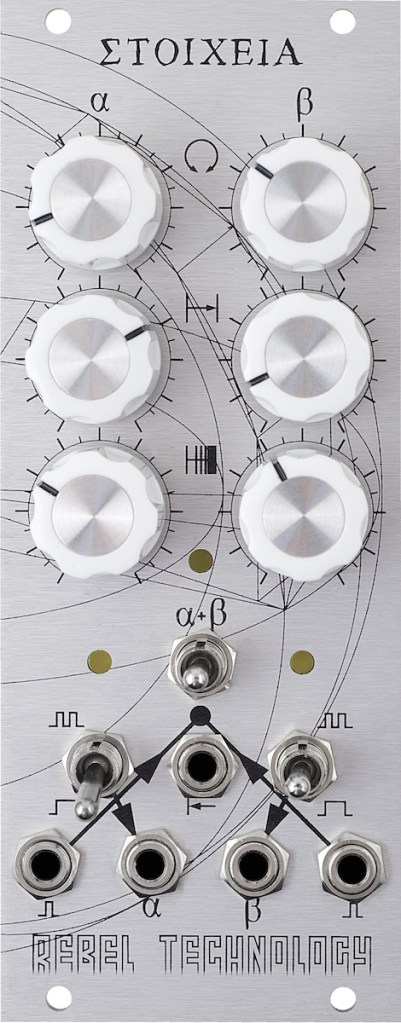
Stoicheia by Rebel Technology
An interesting module with some advanced features for more complex rhythm generation. At first glance, this module runs two lanes of Euclidean sequence, with no CV control other than clock input, and outputs the two gate signals. There is no inbuilt clock and no display.
Where things get interesting are the three switches. Two of these change the modes of each lane from normal gating to a ‘flip-flop’ mode, where each event in the sequence changes the output state from on to off. This can be used to create changing note lengths, or to toggle parameters in a rhythmic fashion, and is rather unusual. The other knob links the two sequences back to back, meaning that you can have first and second halves of the sequence with different hit densities, or even different lengths!
More info here: https://www.rebeltech.org/product/stoicheia/
DIY Modules by various
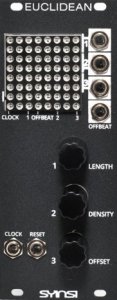
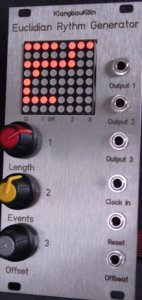
Finally, I found a few DIY modules, which appear to be similar to my ideas, based around ATMEGA chips and LED Matrix displays. They both lack built in clocks or any CV input, and use 8×8 LED matrices to display 16 step sequences, meaning that each sequence must be split over two lines. While this does solve the circular 16 step ring issue, it is still not ideal.
Some very useful build info can be found on one creator’s blog, here: https://syinsi.com/projects/building-the-euclidean/

